

Download our new paper. See a video of the paper being presented.
A collaboration between Mott MacDonald and UWE Bristol‘s Centre for Transport & Society.
At the end of 2018 the UK Parliament’s House of Commons Transport Committee published the report on its inquiry into Mobility as a Service (MaaS). It considers findings and conclusions concerning MaaS in practice and issues of governance and regulation, providing recommendations for government action. The report places emphasis upon the great potential of MaaS and steps that may help realise this while guarding against unintended consequences.
Co-incident with this report, is a new paper we are pleased to have just had accepted at the end of 2018 for publication. It is the first paper accepted for a forthcoming special issue on MaaS in Transportation Research A: Policy and Practice, guest edited by David Hensher and Corinne Mulley. The paper is called “The importance of user perspective in the evolution of MaaS” [1]. The essence of MaaS is about being user-centric and yet we are not convinced that an understanding of the user has been central to developments of, and associated commentary concerning, MaaS to date.
Our paper is freely available to download. You can also watch a video of the paper being presented.
Here are some of the takeaway messages:
Understanding what MaaS is – The report above refers to MaaS as being the digital platform (smartphone app) as the medium for accessing mobility. In our view, MaaS should be interpreted as the ‘mobility system beyond the private car’, within which the mobility intermediary (the digital platform provider) is only one layer in what can be seen as the (prospective) users’ hierarchy of need:

A smartphone app alone does not create a viable alternative to the private car. Such alternatives (physical means) themselves must first exist before higher layers in the hierarchy can potentially add benefit for the user.
Evolution not revolution – The term ‘MaaS’ may be new but the core underlying prospect of providing the user with a more integrated, seamless and convenient experience of mobility beyond the private car is not – it is decades old. The UK Government’s 1998 Transport White Paper prioritised this: “integration within and between different types of transport ‐ so that each contributes its full potential and people can move easily between them”.
Levels of MaaS integration – MaaS is indeed continuing to evolve with changes taking place in all of the layers in the diagram above. MaaS offerings (long established and new) can be conceived of in a similar way to the 0-5 SAE taxonomy for automation of road vehicles. Our LMI taxonomy shown below is user-centric, suggesting that the value offered to (prospective) users by MaaS is governed by operational, informational and transactional integration and in turn the cognitive effort required of the user to fulfil their mobility goals:

Pushing at an open door – The prospects for MaaS are strongly related to changes being observed in users’ lifestyles, attitudes and behaviours. There are significant signs that the motor age is starting to be superseded by a collision between, and merging of, the motor age and digital age. A new mobility regime may be emerging. Younger people are now much less likely to hold a driving licence. Social and business practices are changing with implications for trip rates. People are increasingly engaged in digital activities while on the move.
Hype versus substance – We would align with some other commentators on MaaS in expressing caution over the degree of optimism regarding its prospects in delivering further influence beyond that already achieved in the evolution of MaaS to date. Technologically deterministic rhetoric and limited trials – and limited behavioural insights from them – can foster hype over substance. It is clear more needs to be understood about (prospective) user reactions to trials and implementations of MaaS. Here lies the source of better understanding the true potential of MaaS, including which layers in the mobility system beyond the private car and which forms of integration such potential is most dependent upon.
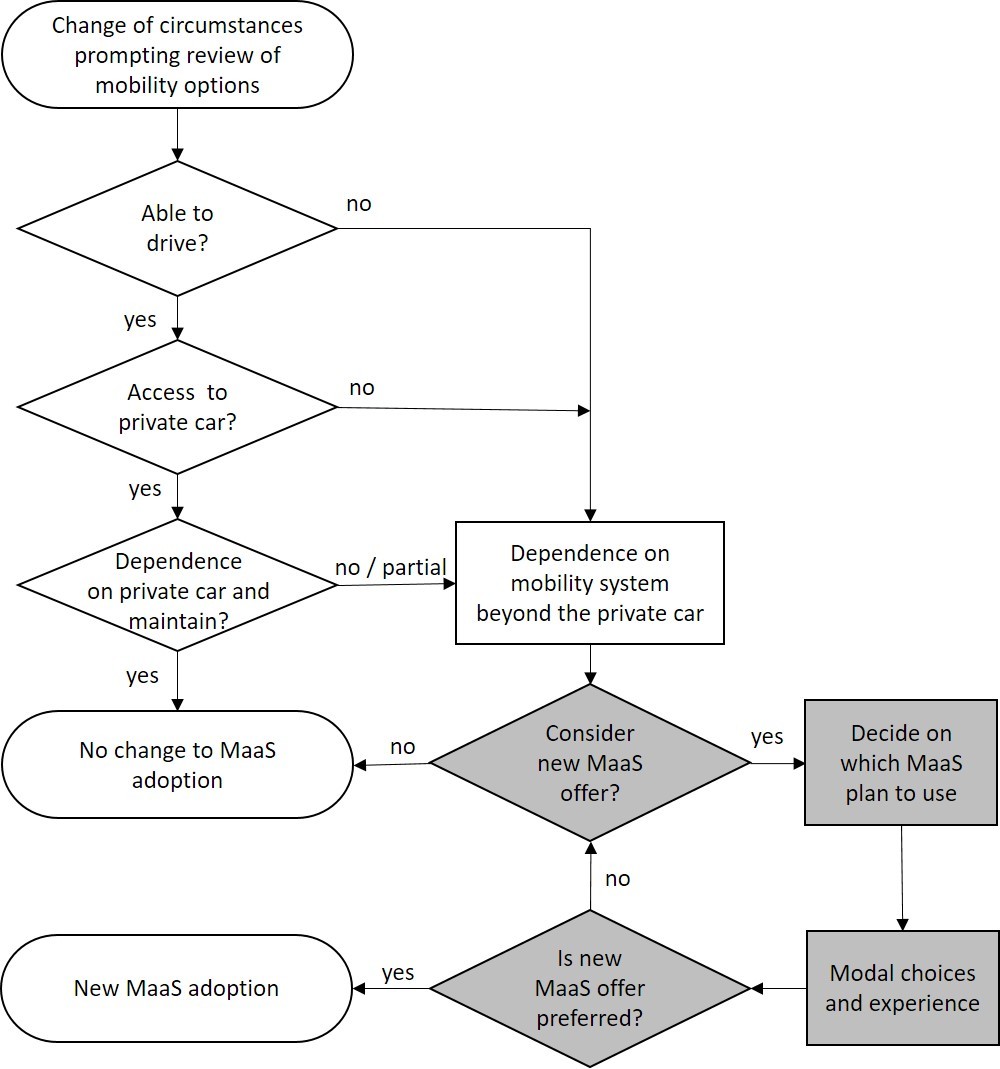
To adopt or not to adopt – The fact that MaaS is not new but is instead an evolving concept is advantageous – it means we can learn much about users’ choicemaking behaviour and information needs from the existing knowledge base. We summarise this in our paper. We have also put forward a behavioural schema depicting a process of consideration of any new MaaS offer that we believe needs exploring further empirically. A particular challenge from a user perspective is weighing up the true ‘cost’ of different mobility packages they could adopt – within MaaS and between MaaS and the private (or leased) car.
[1] Lyons, G., Hammond, P. and Mackay, K. (2019). The importance of user perspective in the evolution of MaaS. Transportation Research A: Policy and Practice, Special Issue on developments in Mobility as a Service (MaaS) and intelligent mobility, Forthcoming. https://doi.org/10.1016/j.tra.2018.12.010
 What the hell is going on?
Leave a comment