
www.mottmac.com/futures
The challenge
Mainstream transport planning has been and continues to be in the ‘forecast-led paradigm’. Yet we are confronted by deep uncertainty about the future as we bear witness to significant behaviour change and technological innovation – brought about in part by the collision and merging of the digital age with the motor age.
My own view is that for some years now we have been in, and continue to be in, a fundamental transitional period for mobility – moving away from automobility towards something new. In this environment, it is no longer sufficient to apply ‘business as usual’ transport planning.
Thankfully we are seeing growing recognition of this – but the challenge is, how do we change what we do in strategic planning to better align with the changing world we are in? I believe we need a regime transition in transport planning in response to the regime transition happening in mobility.
Responding to the challenge – FUTURES
It was a great honour to speak at the 2019 CIHT Learned Society Lecture last night in London where we set out a new approach to planning for the future of mobility. (Videos and slides from the evening very soon to be available I understand.) Indeed, last night was the launch of FUTURES – a six-stage approach to vision-led strategic planning for an uncertain world. FUTURES (Future Uncertainty Toolkit for Understanding and Responding to an Evolving Society) moves us away from predict and provide and instead helps you decide on the future you want and then provide an approach that helps you get there and which is resilient to the uncertainty about the future.
The full FUTURES interactive guide is freely available from www.mottmac.com/futures. There is also an 8-page summary to help you consider whether FUTURES might be something of use to you. Please consider taking a look.
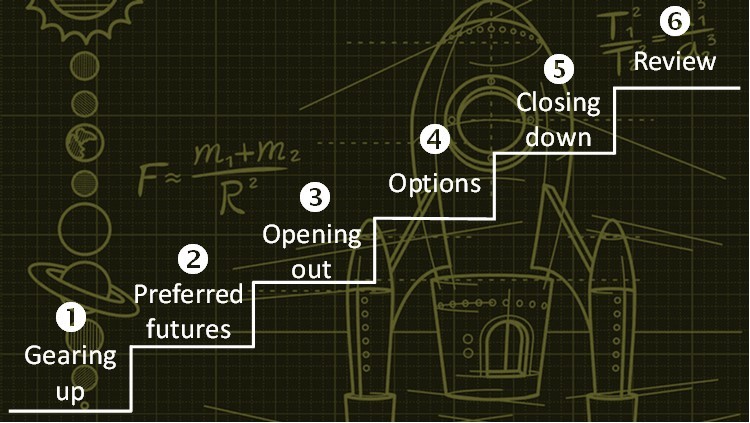
The six stages of FUTURES are as follows:
1. The first stage we’ve called Gearing up. Its about exposing those who are considering following the approach to the rationale behind it. Its about helping them to reflect upon how it differs from business as usual and to appreciate how it can offer a ‘fit for purpose’ approach to planning for the future. Ultimately its about establishing a readiness and willingness to engage.
2. The second stage, called Preferred futures, is about grounding thinking about the future in lessons from past approaches to strategic planning, and in examining ongoing change in order to explore futures that are both desirable and achievable and converge on a shared vision supported by a process of constructive challenge and engagement.
3. The third stage concerns Opening out uncertainty. It’s about exploring the drivers of change and identifying critical uncertainties that give rise to different plausible future scenarios – contexts within which the delivery of the vision might end up taking place and which could affect (or indeed even be affected by) the steps taken to realise the vision.
4. The fourth Options stage, which is likely to be more familiar, is to identify candidate policy options that could help in fulfilling the objectives and outcomes set within the overall vision. Option gathering from wider global experience as well as option generation specific to the context to hand is informed by the prior stages and involves sifting the options to arrive at a shortlist to be taken forward to the next stage.
5. The fifth stage addresses Closing down. This is about stress-testing the options to improve resilience in the decision making. This stage can be especially challenging and uncomfortable as it brings into question analytical robustness and calls for open-minded dialogue and judgement on the part of the players involved. The aim is to see how each candidate policy option plays out across the different ‘without policy’ (or do-nothing) plausible future scenarios in terms of good alignment (green) partial alignment (amber) or poor alignment (red) with the direction of travel towards the vision. The assessment helps consider the trade-offs between yield and risk with the opportunity to look for least regret selection of policy options to form part of the strategy for delivering the vision.
6. With the first five stages completed, the basis for drawing up a strategy is in place. However, the strategy itself marks the end of the beginning, as attention turns to strategy delivery. Uncertainty will not be fixed or fully understood, therefore a sixth and ongoing Review stage is to put in place continued monitoring of change that could inform and influence the strategy and its effectiveness. There should be a readiness to periodically review and, if necessary, revise the strategy and its policies in light of new evidence and signals of change.
Looking to the future of FUTURES
What will strategic transport planning be like in 20 years time, in 2039? I think there is uncertainty over this. While FUTURES represents a ‘decide and provide’ way forward for our stewardship over a better future, is it set to play a part in the transition in strategic transport planning that I advocate above?
To examine this, I have done a scenario planning exercise – not to consider uncertainty over the future of mobility but uncertainty over the future of planning for the future of mobility. I think there are two critical uncertainties – (i) how uncertain we will be in 2039 about the future (compared to today); and (ii) the nature of our stewardship over the future (ranging from weak to strong planning). The four scenarios that result are shown below.
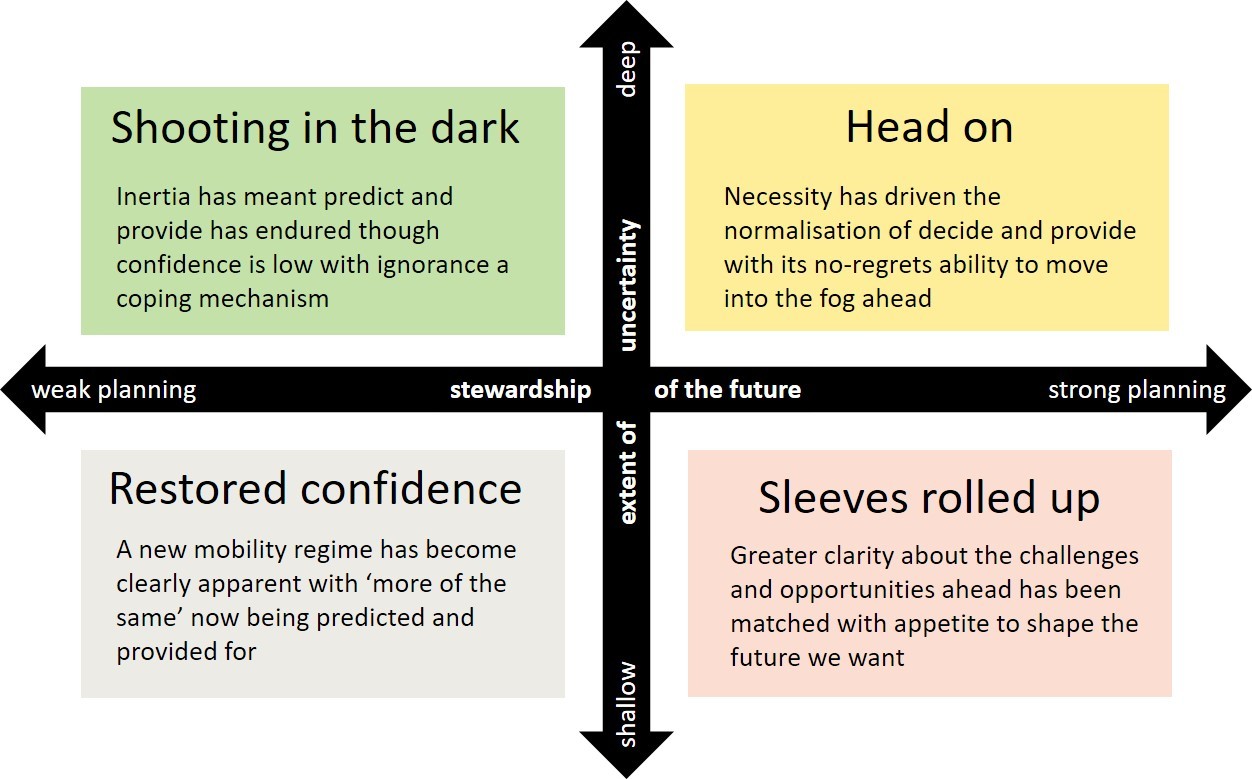
I would suggest that in returning to 2019, the most appropriate thing we can do to accommodate the four plausible scenarios above and hence de-risk our approach to strategic planning would be to make FUTURES part of mainstream practice. I look forward to your views.
 What the hell is going on?
Leave a comment