
My colleague Paul Hammond asked me to come up with five thoughts for the future of transport planning as part of a gathering this weekend of c100 bright minds from within Mott MacDonald’s growing population of transport planners. I thought I’d share them on Linkedin and see what other people’s thoughts are.
1 Black swans
Naseem Nicholas Taleb wrote the book ‘The Black Swan’ which highlights how extreme outliers beyond the realms of regular expectations can unexpectedly have substantial impact. We tend to plan for the normal not the unexpected.
I’m inclined to think that Greta Thunberg is a potential Black Swan (very much in a good way). A 16 year-old Swedish girl with Asperger’s who has mobilised people globally to press for action on climate change. She started as an outlier and for many in society perhaps is still seen as such – with 600k Twitter followers, dwarfed by the 60M following Trump (I’m following one of them).
But her call to arms, alongside Extinction Rebellion and the public reaction to Sir David Attenborough’s exposure of the issues may have started a serious disruption to normal to the extent that we see attitudes, behaviours and our very system of society changing.
For many transport planners motivated by sustainability, this may spell a strengthening of the importance of planning but it may also bring challenges regarding how readily transport planning is able to evolve in response.
2 The rise of heterogeneity
As something of a generalisation, we have a transport system created ‘in their own image’ by middle-aged, able-bodied white men.
Earlier in my career you could sometimes catch someone saying at a conference as a postscript to their main point– ‘we mustn’t forget women, the elderly and the disabled’ (as if they were somehow a minority faction of society).
We have an ageing society. We have young people behaving very differently. We have greater recognition of mental health, diversity in sexuality, cultural diversity. We have a serious strain on two party politics perhaps reflecting a society that is overtly heterogeneous.
Our transport analysis, meanwhile, has centred upon classifying people and what they do in terms of activities and trips. Simplicity has been an ally. We’ve not assumed everyone is the same, but neither has the heterogeneity of society and how it might continue to change been substantially addressed.
We may face a future where this needs to be grasped for technical if not moral reasons if future transport planning is to be fit for purpose.
3 Internet dependence
The car began as a liberating force for individuals in society – it offered independence and opportunity. But over time, as Phil Goodwin observed in the 1990s, we came to rely upon it – we shaped our built environment, our behaviours, our economy and social norms around an expectation of having a car. We became dependent on the car. The societal costs of that dependence in turn became apparent, amplified by population growth.
The internet began as a liberating force for individuals in society – it has offered a new form of access and independence. We are now shaping our built environment, our behaviours, our economy and social norms around expectation of having internet access.
The more bandwidth available, the more demand for it is generated – the bigger the server farms grow and the volumes of data propelled around the system. The internet is not carbon neutral even if it seems more appealing than motorised mobility in this regard. Will we come more and more to refer to internet dependence and its negative connotation?
The internet will continue to affect how we connect in society and the demand for physical mobility. It therefore affects transport planning.
4 Next generation transport planning
Transport planning is ‘man’ made. Its roots are in a different era – the rise of the motor age. Substantially it was about supporting the car and therefore centred upon highways. We developed four-stage models, primarily to analyse car traffic and the benefits of keeping more of it moving. Ministers had a long list of road schemes queuing up to be built – they needed to decide which ones to prioritise. Benefit-cost ratios built upon valuing travel time savings were the order of the day.
Particularly those of you who are earlier on in your careers have inherited transport planning as defined by its origins. But you are the generation who has the opportunity and perhaps the responsibility to shape how transport planning evolves.
In the UK Department for Transport’s ‘Future of Mobility: Urban Strategy’ one quote is that “there will be more change in transport in the next 10 years than in the last 100”. I’m not sure whether I buy that but, nevertheless, transport planning cannot stand still if our profession is to play its part in stewardship over a better future.
My feeling is that transport planning change will be evolutionary not revolutionary. Its in our hands to shape it – but this will require us all to play our part – and have the resilience and patience to see through the change needed.
5 Uncertainty squared
There is, at the moment a sense of deep uncertainty about the future in terms of mobility but also society. This is challenging enough – but add to this the question over whether in 5 or 10 years’ time we will be less uncertain or more uncertain about the future than we are now?
Uncertainty over the future level of uncertainty matters because it affects how fit for purpose our transport planning approaches will be over time.
Some of you wont be surprised that this brings me to FUTURES – a vision-led approach to strategic planning for an uncertain world. Suffice to say that we as Mott MacDonald and UWE Bristol, alongside others, are playing our part in the evolution of transport planning.
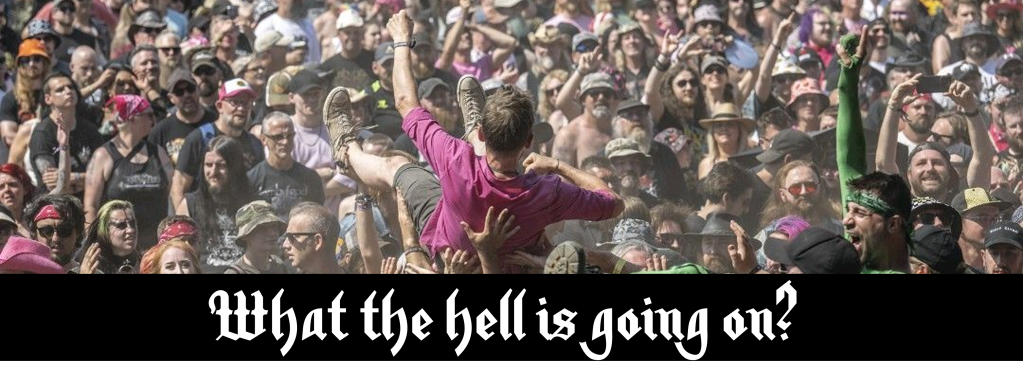
 What the hell is going on?
Leave a comment