
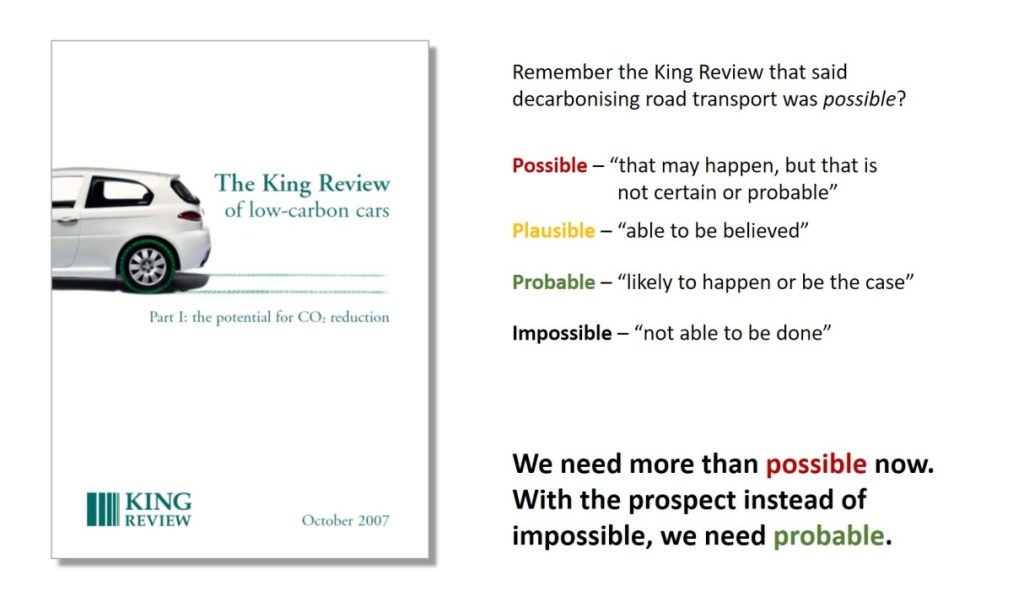
12 years ago the UK Chancellor asked Professor Julia King to “examine the vehicle and fuel technologies that, over the next 25 years, could help to decarbonise road transport, particularly cars”.
Her report noted that “The global challenge is to support increases in road transport use, in a sustainable, environmentally-responsible way” [emphasis added]. It considered that “In the long-term (possibly by 2050 in the developed world), almost complete decarbonisation of road transport is a possibility” [emphasis added].
The King Review pointed out that to achieve this possibility, substantial progress would be needed in:
· Cleaner fuels
· More efficient vehicles and
· Smarter driver choices.
While I understood at the time that the review’s brief was to look at what could be achieved with vehicle and fuel technologies (in the face of accepted (?) traffic growth forecasts), I remember being drawn to the third bullet point above. What choices? And why ‘driver’ and not ‘traveller’ choices? The report outlined that smarter driver choices meant:
(i) demanding new technologies (smaller, cleaner, more efficient cars);
(ii) driver efficiency (tyres pumped up, controlled acceleration, minimum luggage); and
(iii) small reductions from travel (as opposed to driver) choices (avoiding low-value journeys, use of alternative modes, car sharing).
In 2007 I felt that foregrounding technological change overestimated potential for the rate of technological innovation (in terms of the pace and scale of its diffusion) and underestimated the potential for behaviour change.
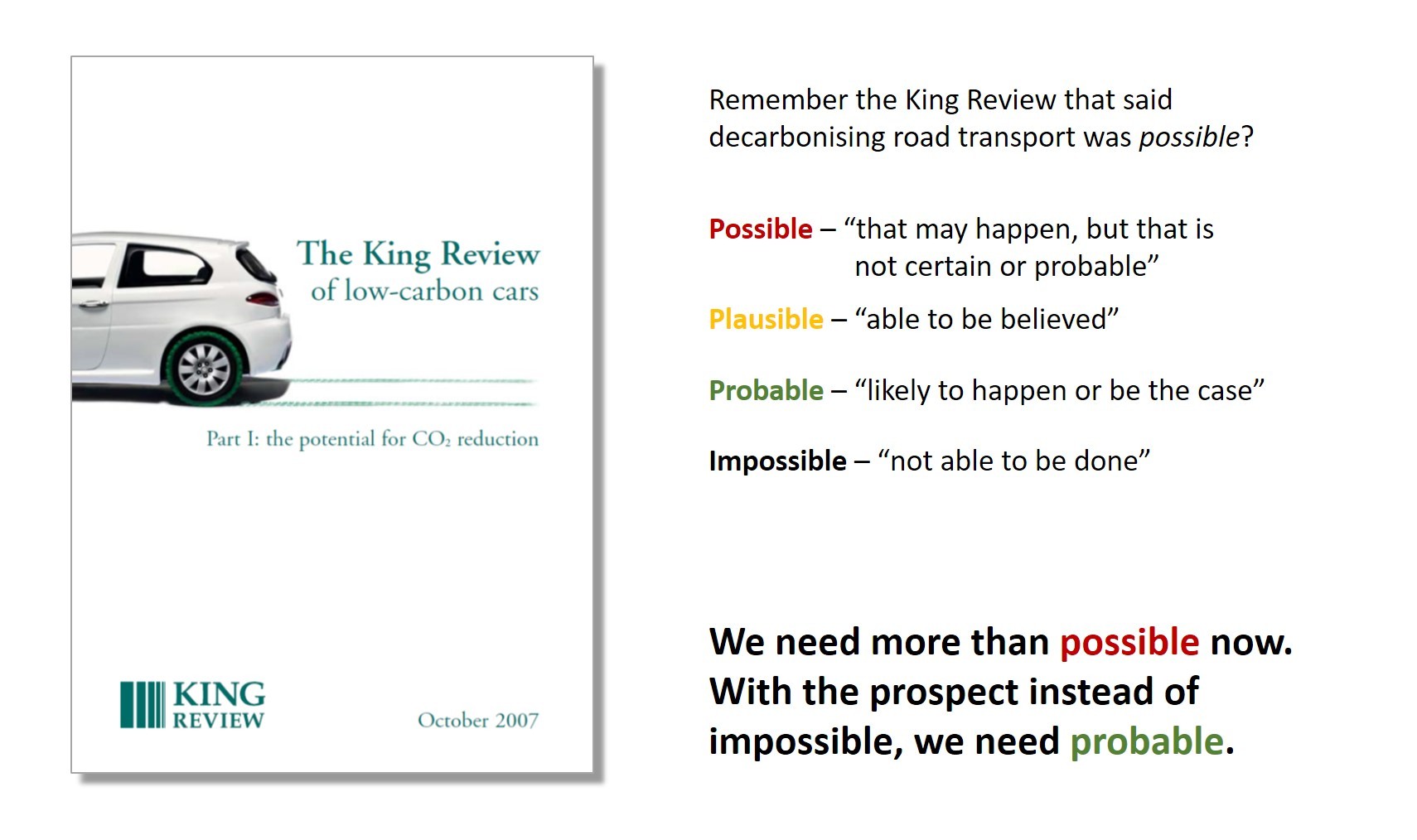
With legally binding plans announced last month to achieve net zero carbon emissions by 2050, is almost complete decarbonisation of road transport a possibility, 12 years after the King Review suggested it was? The Figure below from the Climate Change Committee’s 2019 progress report on reducing UK emissions suggests ‘possible’ (if not ‘impossible’) is indeed a more appropriate term than ‘plausible’ or ‘probable’.
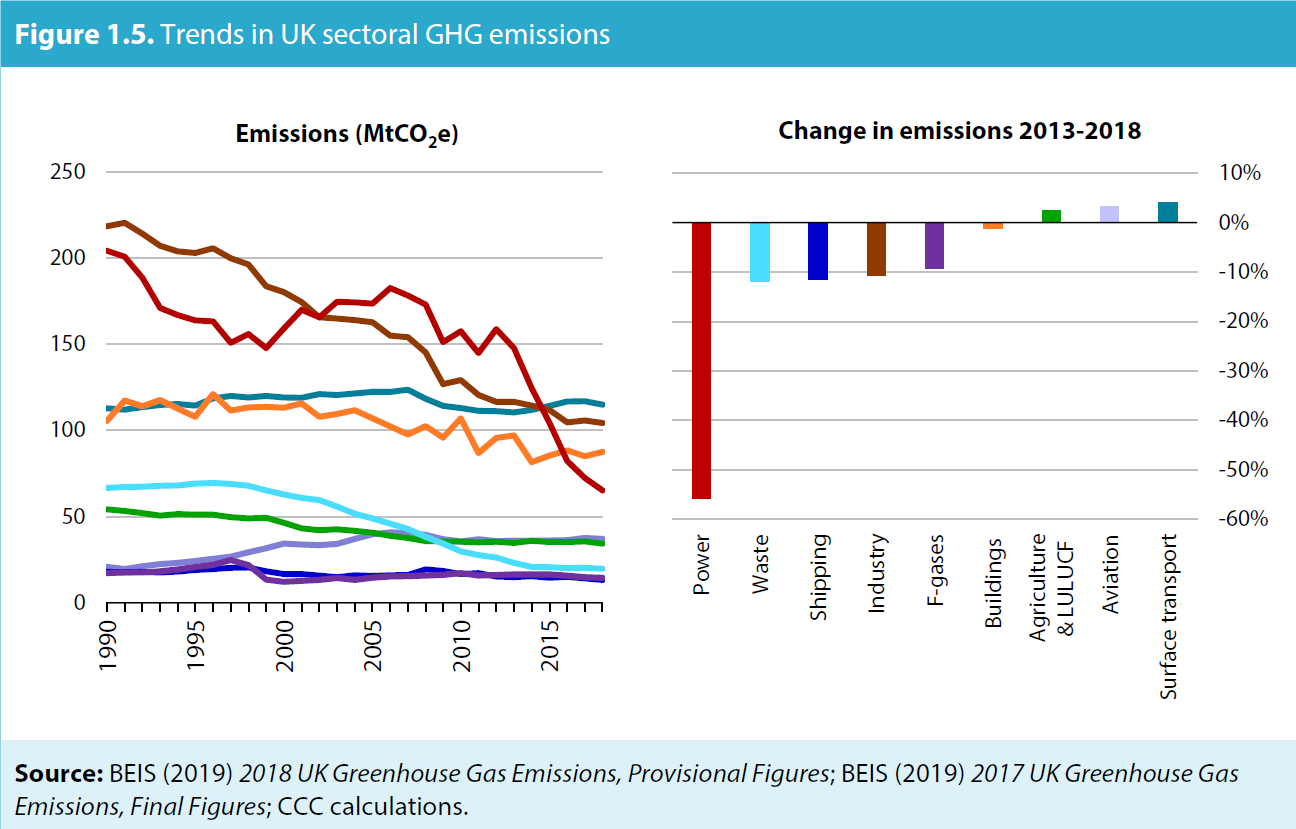
From https://www.theccc.org.uk/publication/reducing-uk-emissions-2019-progress-report-to-parliament/
Now like never before we need to see the transport sector stand up and be counted. It has to be about travel behaviour change as well as technological innovation. And we may be pushing at an open door with encouraging signs of change. Take just one statistic from the work led by my UWE Bristol colleague Kiron Chatterjee for the DfT into young people’s travel behaviour: “29% of all 17-20 year olds had a full driving licence in 2014 compared to 48% in 1992/94”. That’s a big change – bigger than we have seen since the King Review for that resulting from technological innovation in the road transport sector. We must innovate socially as well as technologically and we must do so with urgency and determination.
 What the hell is going on?
Leave a comment