
As you may know, I am a big fan of ‘Walking as a Service’ (WaaS). Thanks to Silicon Valley harnessing the power of geography in the form of Google Maps Navigation, three key questions that could stand in the way of choosing to walk can now be answered: How do I get there? How far is it? How long will it take?
In preparing a paper to examine WaaS, I have taken a closer interest in the available National Travel Survey (NTS) data over time for walking trip rates. These reveal something rather remarkable as shown in the graph below. Walking trips under 1 mile per person in England have shown a sharp increase since 2015, contrary to a trend of decline over previous years.

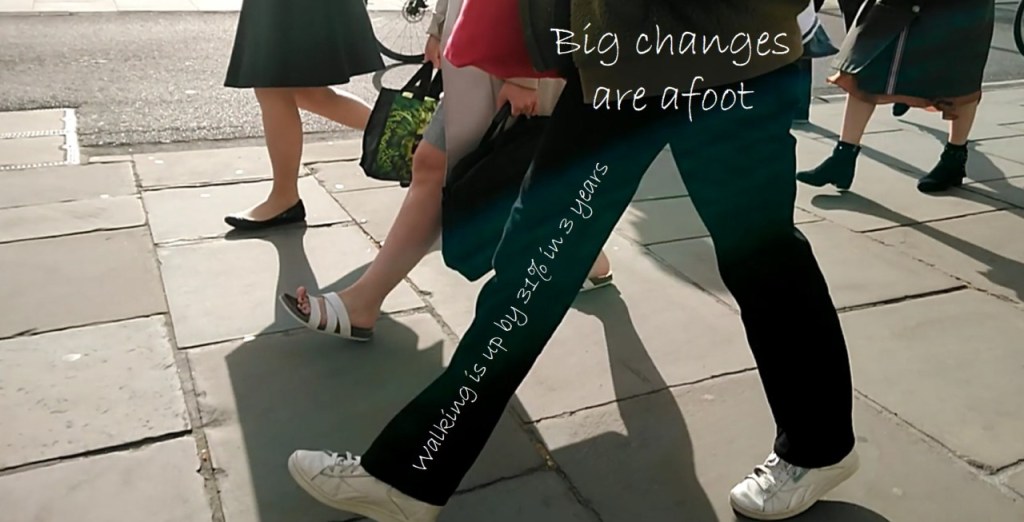
The latest 2018 NTS figures show further growth from 2017, albeit more modest than the previous year-to-year increases. A 31% increase in walking trips under one mile over a three-year period leaves one tempted to use the phrase ‘walking renaissance’.
The key question that immediately arises is why has there been such a sharp increase in walking trips?
There are two possible explanations that need to first be considered and (hopefully) discarded:
(i) Glenn has wrongly interpreted the NTS data; and
(ii) the NTS methodology has changed.
I’d like to think that the first of these is not in play. If you want to check, the source NTS data for the graph I’ve produced above can be found at https://assets.publishing.service.gov.uk/government/uploads/system/uploads/attachment_data/file/733109/nts0308.ods
The second explanation may be in play. Walking and shorter trips in general can be under-reported in surveys. The NTS for England (running since the 1960s) uses a 7-day travel diary. Short walks (over 50 yards and under one mile) were historically recorded on the seventh day of the diary. With recognition that under reporting can increase towards the end of the 7-day period, in 2016 an experiment with recording short walks on day one of the diary was run and then fully implemented for the 2017 NTS. The DfT has “revised the back series from 2002 to 2015 to account for the previous under-reporting” (DfT (2019) – National Travel Survey Quality Report. Department for Transport, January. Available at: https://assets.publishing.service.gov.uk/government/uploads/system/uploads/attachment_data/file/775062/annex-d-nts-2019-quality-report.pdf). If this statement is indeed correct then it suggests that the significant methodological change to the NTS is not responsible for the sharp increase in walking trips.
If both the above explanations can be discounted then what other explanations might exist?
In such a short space of time, it cannot be due to land-use changes or changes to the walkability of the built environment. This then points to the prospect that it could be due to other influences on people’s behaviour.
It should be noted that trips by all modes under 1 mile have increased more or less in line with the increase in walking trips (albeit that walking trips account for 79% of all trips under 1 mile for 2018). Therefore it cannot seemingly be a change in mode choice for the same destinations. Does it instead point to people changing their destinations and perhaps journey purposes such that they are becoming more active at a more local level in their daily lives? Could WaaS be playing a part in this, especially in cities, as it becomes easier to identify activity locations, co-ordinate with others, and get there on foot independently?
I don’t have the answers at this point. Part of me is expecting the Department for Transport at any moment to offer an underwhelming explanation that dispels the notion of a walking renaissance. However, we surely need to be pursing an explanation if this is not the case. At a time when we need to identify a pathway to decarbonising transport, walking could have a major part to play – and perhaps it is already ‘stepping up’ to the challenge?
I would very much welcome your views and ideas.
 What the hell is going on?
Leave a comment