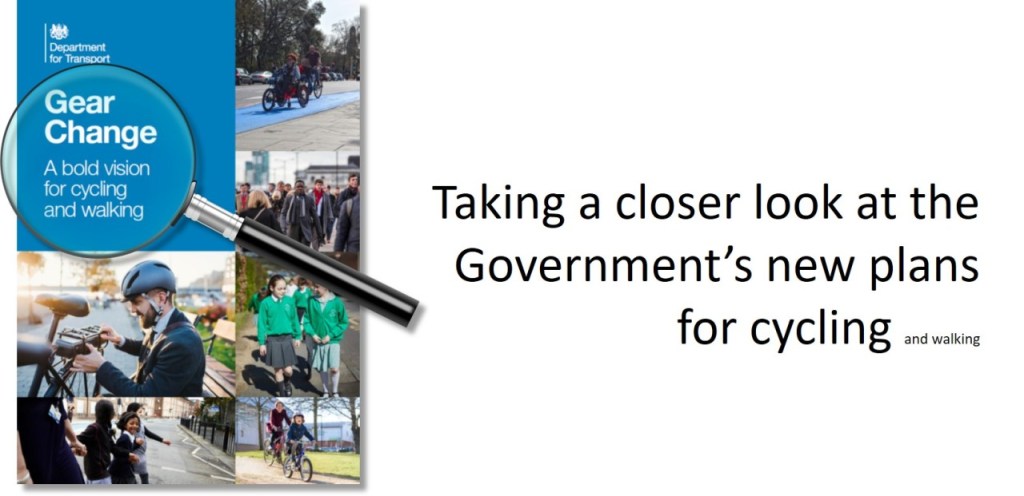
The UK Department for Transport yesterday published “Gear change: a bold vision for cycling and walking”. After my early morning walk (see highlight pictured below), I sat down with an air of anticipation to read the document from cover to cover. Was this what transport planners have been waiting for and what the wider public might now have a much greater appetite for in light of the pandemic? I’ve set out below, the 10 things that stood out for me from my reading.
Full of goodness
There has been much speculation of a ‘new normal’ emerging from the troubled times we are currently living through. This document offers a source of inspiration. It talks boldly about the importance of active travel moving into the mainstream of how places and people’s lives function. It says that “we need to think harder about our health” – surely something that resonates will most if not all readers; yet of course thinking needs to turn into action (this, one assumes is the purpose of the document). “Places will be truly walkable. A travel revolution in our streets, towns and communities will have made cycling a mass form of transit. Cycling and walking will be the natural first choice for many journeys with half of all journeys in towns and cities being cycled or walked by 2030.” This is to be celebrated as timely (if not overdue) and sets out a new repertoire of ways and means to help achieve this. To me it speaks to ‘decide and provide’ rather than ‘predict and provide’. This is supply-led demand instead of demand-led supply, recognising that behaviour changes in response to the environment it is presented with.
It’s really a vision for cycling
In light of the sense of inspiration that the document offers, it might then seem churlish to express a great sense of disappointment in one important respect. Yet this needs to be said. If you read this document from cover to cover, you will find that it is very much about a gear change rather than a step change (from its title, to the table of contents, to the Foreword, and then into the substance): this is ostensibly a vision for cycling with a smattering of mentions of walking for good measure. For example, Theme 2 in the Table of Contents is called “Cycling at the heart of decision-making”. Even though the full title in the document itself is “Putting cycling and walking at the heart of transport, place-making, and health policy”, there is hardly a mention of walking. (And I could see no commentary in this section on putting active travel ‘at the heart of health policy’.) I’m left wondering whether it would have been better to simply call this document a vision for cycling. Yet were this the case, one would expect a vision for walking to follow. To underline that this is not a vision for walking, there is not the slightest mention of pavement parking and the obstruction that this represents for pedestrians.
Walking matters
“Vast numbers of car journeys are very short and could easily be travelled by bicycle” says the document. This is of course true, but also true for walking – with a 30% increase in trip rate for walking trips under 1 mile from 2015 to 2018 (according to the National Travel Survey). And if we are wanting to foster a renaissance in active travel to help realise positive social outcomes then the barriers to walking are lower than for cycling (for most people). The ‘vehicle’ I need is probably in my wardrobe. I don’t need to buy a bike or wait for a cycle-hire scheme that I may feel awkward about using. In fact, the vast majority of people already walk – its not a new behaviour – its simply a behaviour (with the right encouragement and improvements to the walking environment) that needs to be performed more. The document makes reference to the value of active travel to boosting local businesses with its passing trade. To my mind, people are more likely to engage with high street businesses when they are passing on foot than when on a bike. This is not in any way to be anti-cycling but rather to underline that walking matters too and perhaps even more so than cycling in terms of the number of people it can benefit.
A new Ofsted
The vision announces the proposed formation of Active Travel England – intended to be similar to Ofsted in terms of “raising standards and challenging failure”. It is noted that “[t]he cycling budget will be held by a new commissioning body and inspectorate, Active Travel England, led by a new national cycling and walking commissioner which will be established in the next few months.” There will be “a long-term cycling and walking programme and budget, like the roads programme and budget”. I’m sure this does not mean a budget of £27bn over the next five year ‘like the roads programme’ but greater clarity over forward funding is welcome. There is mention too that Active Travel England will be a statutory consultee within the planning system “to press for adequate cycling and walking provision in all developments of over a certain threshold”. This sounds positive in principle, but what about in practice? It is not clear what ‘over a certain threshold’ means. Is this a loophole for incremental developments (below the threshold) across the country that do not deliver such provision?
Not a tech bro in sight
Just over a year ago, The DfT published “Future of Mobility: Urban Strategy” which I wrote about at the time. The Foreword of that document began with “Britain is on the verge of a transport revolution” and two sentences later had got onto “radical new technologies are emerging that within a generation will transform everyday journeys” followed by reference to zero tailpipe emission cars and self-driving vehicles. It is a document that tries to square the circle of supporting the Industrial Strategy and addressing sustainable transport. Not easy. This new ‘Gear change’ vision seemingly addresses principle three of the Future of Mobility: “Walking, cycling and active travel must remain the best options for short urban journeys”. What is refreshing is that this vision is addressing ‘here and now’ low-tech solutions that can be delivered at scale to make a real difference to people’s lives. This said, there is no mention in the document of how walking and cycling may be affected if and when some of the ‘radical new technologies’ come on stream. For example, where will all those ‘robot’ delivery vehicles fit into this vision of reallocated street space for active travel? I was taken by reference in the Foreword to bicycles and bike lanes coming to resemble huge 24-hour gyms. It took me back to a shrewd observation from Phil Goodwin many years ago, highlighting the irony that people drive to fitness centres to go on cycling machines – why not walk or cycle to an amusement arcade to go on a driving game instead he suggested.
Changing priorities for streets
Since I’ve been working with Mott MacDonald, I’ve many a time walked across Blackfriars Bridge in London and been inspired by the volumes of active travel – boosted by a reallocation of roadspace incorporating a stretch of Cycling Superhighway. It has reminded me of the William Gibson quote “the future’s already here, its just not evenly distributed”. I was therefore delighted to see Blackfriars Bridge mentioned, fittingly, more than once in the document as it moved into setting out intentions for reallocating roadspace including physical separation for cyclists, closing roads to through traffic, “parking restrictions at school pick-up and drop-off times” for ‘school streets’, and discouraging cycling provision that shares space with pedestrians (something I’ve actually found quite challenging in the Blackfriars area as a pedestrian). So how readily will funded schemes to change roadspace allocation come into existence? “We will consult on creating a community right to close side streets and create low-traffic neighbourhoods, with groups of residential side streets able to petition local authorities for rat-run closures” – I like this proposition but am left wondering whether the flip-side of the coin could become a problem: groups of residential side streets able to petition local authorities to prevent closures?
Glass half full or half empty?
The vision (and funding) contains an exciting array of intended developments. But is it going to deliver the scale and pace of change that is warranted? The document refers to “[a] once in a generation chance to accelerate active travel” but what of the ambition it sets out? “We will choose up to 12 willing non-London local authority areas, to benefit from intensive investment in mini-Holland schemes” it says. There are 343 local authorities in England – 311 excluding London Boroughs – this amounts to up to 3-4%. “We will create at least one zero-emission city” is mentioned in one short paragraph – if this started tomorrow it would be amazing to have truly achieved this in 10 years. Yet according to https://www.climateemergency.uk/blog/list-of-councils/ the majority of councils have declared climate emergencies, many pledging to decarbonise by 2030. How will they do it? The boost to active travel is unprecedented: “[t]he £2bn of funding for cycling and walking that the Government announced in May is new money, representing a sixfold increase in dedicated cycling and walking funding – the biggest increase this country has ever seen.” But to be frank, we are living in unprecedented times that need truly unprecedented action.
Storage solutions
It is encouraging to see that cycle storage solutions are accounted for as part of the vision – particularly in the context of integrating cycling and public transport. “We will invest substantial sums on safe cycle routes to stations, particularly in commuter towns such as Guildford, and increase cycle storage at stations, including at city-centre termini, where it is currently limited.” This is great in principle – but ‘increase cycle storage’ needs to read “create a step change in the capacity and security of cycle storage at stations” (though the document does, under Theme 4, refer to tackling bike theft). It is also a challenging prospect to try and allow more bikes on trains given rail capacity constraints (notwithstanding that the document notes that “We will continue to restrict bikes on peak-hour commuter trains, where the space is needed for passengers”.
Cycle of inequality
Theme 4 is titled “We will enable people to cycle and protect them when they cycle”. A question that should have been (more fully) addressed in the document in my view is, how well geared to addressing inequality will this vision be? Is it assumed that low income households have the means to purchase (more than one) bike and the space to conveniently store it/them? “We will work more closely with the NHS, incentivising GPs to prescribe cycling” says the document in helping to address public health. So what does the GP do when the patient says “I can’t afford a bike, I feel unsafe on a bike, I have nowhere to store a bike”? Prescribing cycling might be the answer for the middle classes in suburbia and rural areas but how universally useful might it be? (it should be noted that cycles for loan are mentioned.) The vision does intend to “incentivise GPs to prescribe cycling wherever appropriate” – but what about when not appropriate? To my mind, this is where walking would come in! There is reference to a national e-bike support programme but the tenor of the statement “[t]hey are particularly useful for people who, for example, need to ride in business clothes without breaking sweat, or to ride up hills, or to travel long distances, who are older or less fit, or who are otherwise put off by the physical effort of an ordinary bike” puts the privileged at the top.
Proof of the pudding
As with any vision, it is turning intentions into actions and achieving results that is what really matters. There is much to be applauded in this document but it also raises a number of questions, as touched upon above. If this is a once in a generation opportunity then it must be seized with both hands and moved forward with a scale and conviction that creates momentum to deliver transformative change. And please can we have a vision for walking too.
 What the hell is going on?
Leave a comment