I feel a low level sense of grief for the naivety & ignorance I have left behind – when I was inside the Matrix, consuming as if magic put the shiny fresh things in the shops, consuming the trivia & the air-brushed media, believing that grown ups existed whose job it was to make everything alright in the end.
I’ve become the odd guy in my circle of family & proximate friends – Glenn who if you’re not careful will take you into a conversation about climate emergency; you know, the one who doesn’t fly any more, wont eat meat & doesn’t seem at all interested in the footie.
Meanwhile in my career it’s like groundhog day. Pleadings among professionals for politicians & public to see the light & grasp the nettle of fundamental change needed in how we live our lives & its dependencies on travel; pledges & policy promises that emerge but that are then watered down into timidity of action. Wash, rinse, repeat.
Echoing Greta in calling for recognition that the house is on fire & emphasising the (growing) gap between what is necessary & what is being done to avert what lies ahead on the climate change path has given me a sense of purpose. But what happens when you start to feel a sense of futility in that purpose?
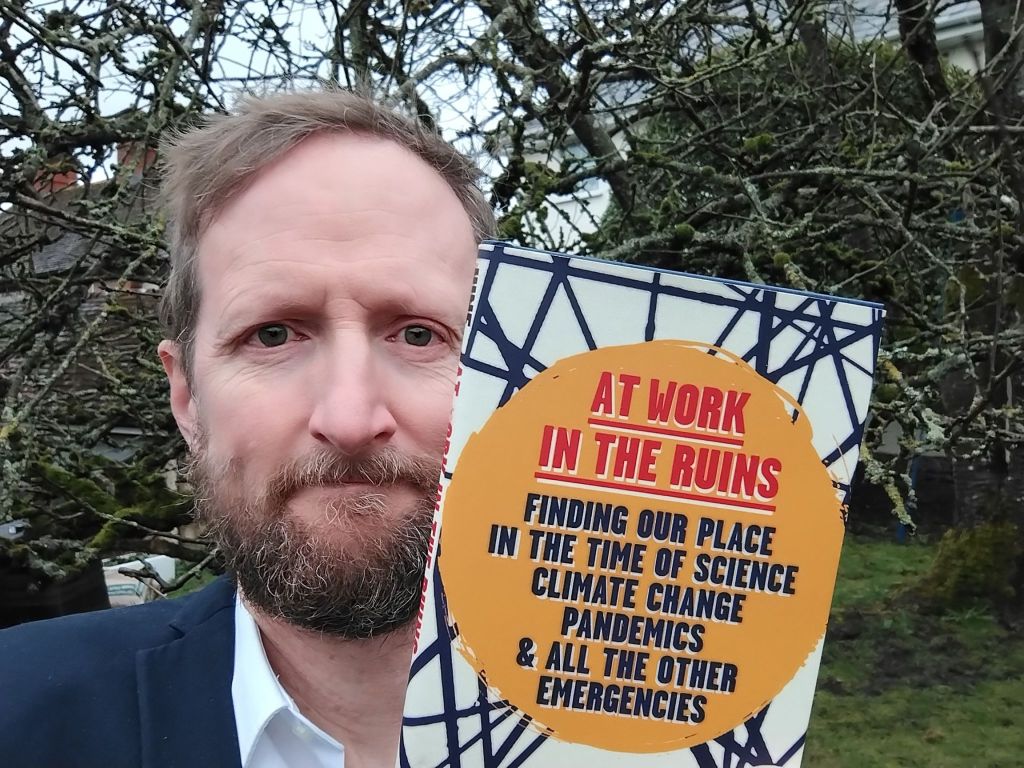
Thankfully, Zoe Cohen posted a book recommendation – “At work in the ruins” by Dougald Hine. I’m hungrily reading it. It really feels like it was the book I was needing: something to give me hope – not that we can find our way out of this desperate mess that humanity has wrought on itself & other life on earth, but hope that I could make sense of it & come to terms with it.
An early point that has struck home is the distinction between a problem & a predicament. I’ve often distinguished between simple & wicked problems – problems that can be solved & those that an only be managed. It seems that a predicament takes this a step further.
“We are all going to die” Dougald Hine says of the opening slide for a lecture he gave to students. This is a predicament. Cryogenics is to treat death as a problem rather than a predicament. We must consider how to treat it as a predicament. Direct air carbon capture & storage is to treat the climate crisis fuelled by modernity as a problem not a predicament. We need to come to terms with the more fundamental nature of how humans are running & ruining life on earth. This is to be at work in the ruins.
As the author explains, our global system means we can iron out localised failures of harvests or supplies of raw materials & products. “This works until it doesn’t, until the frequency of local crises strains the global system to breaking point”. And here’s one of the sickening points that follows: “In the meantime, while the system holds, it means that those whose ways of living place the most strain upon that system will be the last to notice”.
The system is living on borrowed time. I’m clasping the book & its precious contents – now more hopeful of how to live with the predicament & in the ruins.
 What the hell is going on?
Leave a comment