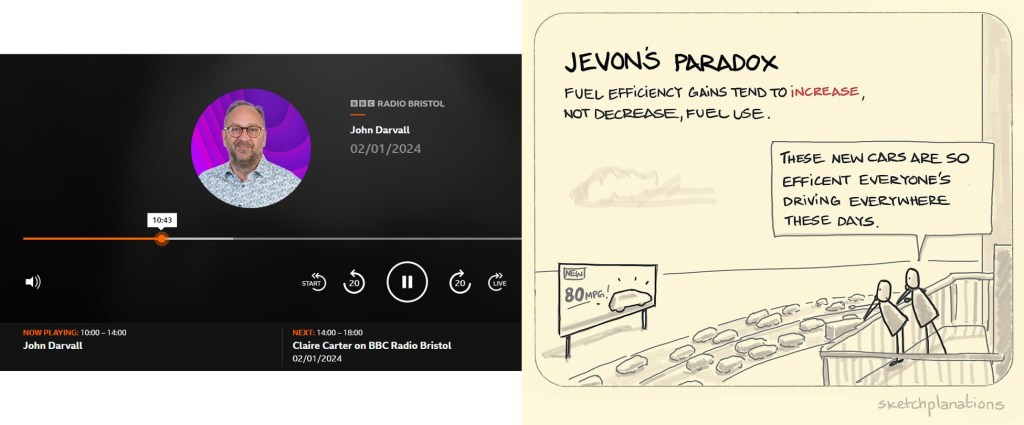
The transition to electric vehicles is in full swing and in the news, while I’ve been worring about Jevon’s Paradox.
I’ve just done my first BBC Radio Bristol interview of 2024 on the topic of the EV transition. Putting aside politics and other matters about addressing the climate emergency, transitions are fascinating – especially as we sit in the midst of one. With an hour’s notice to prepare for the interview, I was reminded of all the variables in play, prinicpally involving vehicle supply, charging infrastructure availability and consumer appetite – and of the choreography between these. We are going up the s-curve. With around 16% of new vehicle registrations being pure BEV in 2023, we have moved from the ‘early adopters’ into the ‘early majority’ phase of the diffusion of innovation. Sure, there will be stories of individual transitional problems but increasingly these will be outweighed by a normalisation of driving electric.
Though the interview did not go into this, what has been on my mind as we moved from 2023 to 2024 has been Jevon’s Paradox (thanks sketchplanations for the image). “Jevons paradox occurs when technological progress or government policy increases the efficiency with which a resource is used but the falling cost of use induces increases in demand enough that resource use is increased, rather than reduced” (thanks Wikipedia).
I’m not just worrying about more car miles as a result of the transition to EVs. I’m worrying that technological ‘solutions’ to our current societal problems may end up doing more harm than good. For example, if science cracks nuclear fusion to deliver ‘clean, limitless energy’ and we add to that AI, and flying cars, and trips to Mars, and drones everywhere, and quantum computing, and, and, and….then where will that take us? Capitalism, our appetite for convenience and consumption, and short-term interest it seems to me pose a huge risk as part of modernity. Even if CO2 starts to look like it is being tackled, can (quality of) life on earth really have the prospect of improving in the face of Jevon’s Paradox and lack of political will to manage demand? Will sustainability, and equality, diversity and inclusion hold much prospect of being prioritised as part of all this ‘progress’?
So, while in the short term I’ll be pleased to see the transition to EVs continue if all else were equal, the reality is that all else is very very unlikely to be equal and so the dance will continue.
I refer you to a 2006 article by Alan Atkinson called ‘Sustainability is Dead – Long Live Sustainability’:
“At precisely the moment when humanity’s science, technology, and economy have grown to the point that we can monitor and evaluate all the major systems that support life, all over the Earth, we have discovered that most of these systems are being systematically degraded and destroyed by our science, technology, and economy”.
hashtag#transitions hashtag#electricvehicles hashtag#jevonsparadox

Thoughts, insights and rants about futures, climate change, system change, transport, wicked problems, EDI, and heavy metal
By Professor Glenn Lyons
 What the hell is going on?
Leave a comment