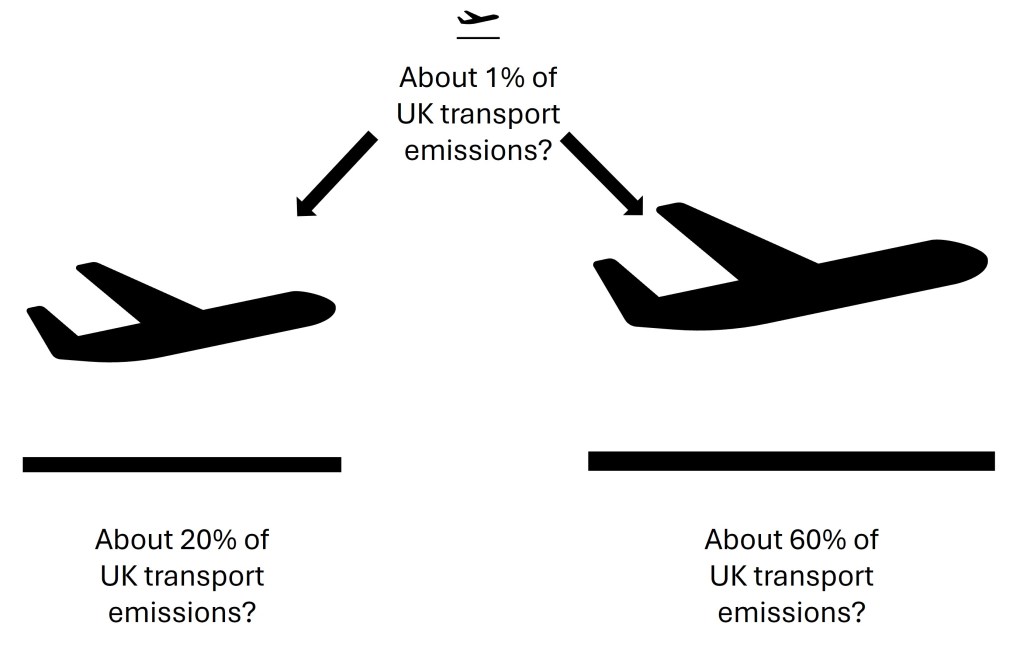
Bunkers or bunkum? Once upon a time there was a flight of fancy that aviation only accounted for 1% of UK transport emissions. Then international aviation was included and this increased to 20%. New ‘bottom-up’ research suggests the figure is more like 60%. What the hell is going on?
Academic colleagues Zia Wadud, Adeel Muhammad and Jillian Anable recently had a paper published in nature energy (wow!) called “Understanding the large role of long-distance travel in carbon emissions from passenger travel” (see https://www.nature.com/articles/s41560-024-01561-3).
In this paper they demonstrate empirically (for 2017) that total CO2e emissions from domestic travel (within Britain) is lower than that from international travel (mainly flying) by residents of England. According to their figures, international travel makes up 59% of the combined carbon emissions from travel by residents of England.
Meanwhile the final UK Government reported figures for 2022 indicate aviation (domestic+international) making up around 20% of total transport emissions (see https://www.gov.uk/government/statistics/final-uk-greenhouse-gas-emissions-national-statistics-1990-to-2022)
The paper explores in some detail the many factors in play that lead to headline statistics such as these being produced which can help explain such a ‘discrepancy’.
I’m imagining a Select Committee series of questions of the authors and of DfT:
1. According to the analysis in this paper would it be correct to say that aviation accounts for around half of all emissions from use of transport for the UK?
2. According to the Government’s published final emissions for the UK Economy would it be correct to say that aviation accounts for around a fifth of all emissions from use of transport for the UK?
3. Would it be correct to say that if both are ‘right’ but representing different things then we need to be clear which of them should be the basis for informing policymaking and investment?
4. Are we clear, and which one is relied upon (most) and why?
We may well wish to focus on the modal hierarchy in terms of local transport planning, with more walking, wheeling and public transport use being broadly seen to be a good thing. Yet in terms of decarbonisation this seems to pale into insignificance when we turn attention properly to (long) haul flights.
With Jet Zero being the (former) Government’s strategy for aviation which assumes 70% growth in aviation and in turn would achieve a level of annual emissions in 2050 of around half those of today, it seems rather important to know what numbers and assumptions are in play.
Thank you to the authors for this hugely thought-provoking paper. But sat alongside the Government’s figures I am currently left wondering what the hell is going on.
Just how big is this elephant in the room? Plain engish explanations gratefully received! 😉
#aviation #decarbonisation

Thoughts, insights and rants about futures, climate change, system change, transport, wicked problems, EDI, and heavy metal
By Professor Glenn Lyons
 What the hell is going on?
Leave a comment