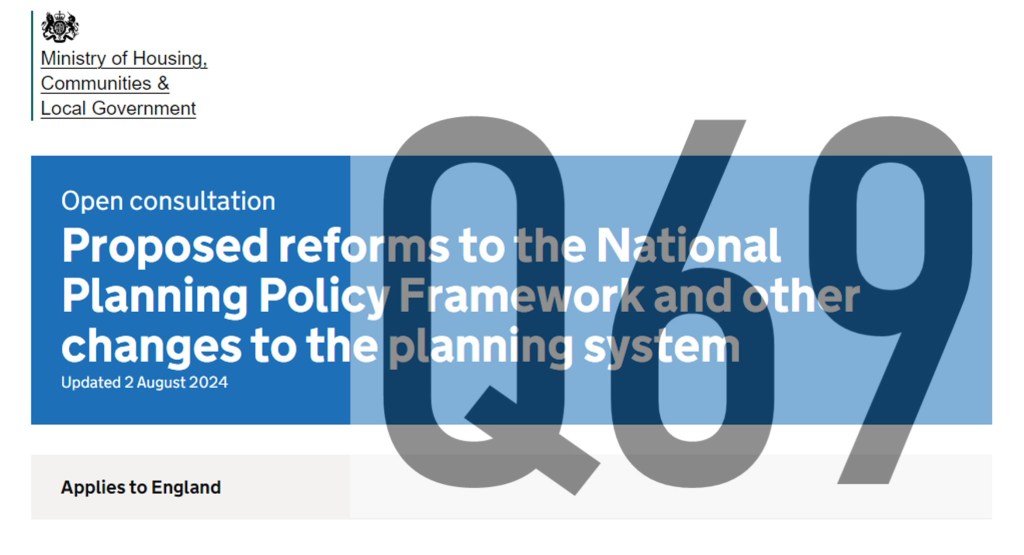
Does ’69’ have meaning for you? I’m not talking about the sexual connotations. I’m talking about what is now lovingly referred to by those of us in the world of ‘decide and provide’ planning as Question Sixty Nine.
The National Planning Policy Framework (NPPF) was published in 2012 and has seen revisions and updates in 2018, 2019, 2021, and 2023. And yet car-centric planning has seemed all but unshakeable.
Then a month ago another attempt at revising it emerged. Not so long ago we went through something similar with the revised National Networks National Policy Statement (NNNPS). There were two frustrations there: (i) no-one thought to use tracked-changes in the revised version to allow us to see easily how it had changed; and (ii) the revised version still had all the hallmarks of ‘predict and provide’ transport planning.
Oh, how the world has moved on. The revised NPPF is out for consultation and: (i) it is presented with tracked changes (a victory for common sense); and (ii) there are two tracked changes that have got people excited: “a vision-led approach” and “in all tested scenarios”.
While the revised NPPF itself is ‘only’ 84 pages long, the consultation includes a whopping 106 questions. But it is Q69 that stands out: “Do you agree with the changes proposed to paragraphs 114 and 115 of the existing NPPF?”
Why get excited over those two tracked changes? It’s a fair question because: the revised NPPF, like the current NPPF, only has one instance of the word ‘predict’; it only has one more instance (nine in total) than the current NPPF of the word ‘vision’; and it has only one instance of the word ‘scenario’ (one more than the current NPPF).
To be honest, paras 6 and 7 in the consultation document preceding Q69 have more impactful text than the revisions to the NPPF itself: “Challenging the default assumption of automatic traffic growth, where places are designed for a ‘worst case’ peak hour scenario, can drive better outcomes for residents and the environment. It means working with residents, local planning authorities and developers to set a vision for how we want places to be, and designing the transport and behavioural interventions to help us achieve this vision. This approach is known as ‘vision-led’ transport planning and, unlike the traditional ‘predict and provide’ approach, it focuses on the outcomes desired, and planning for achieving them.”
👀 Why not include this text in the actual NPPF?!
According to numerology, 69 is an ‘angel number’. From reading up online (Benzinga Living) it seems that keeping seeing ’69’ is:
6️⃣ 9️⃣ a strong reminder to make a choice that will help find stability and balance
6️⃣ 9️⃣ an encouragement to use your skills, knowledge, actions and energy to help make the world a better place
6️⃣ 9️⃣ a sign that one chapter is about to end as another begins
6️⃣ 9️⃣ a beacon of hope when things are rough and you seem lost
Hmmm – did those folks at MHCLG deliberately place that as Question 69?

Thoughts, insights and rants about futures, climate change, system change, transport, wicked problems, EDI, and heavy metal
By Professor Glenn Lyons
 What the hell is going on?
Leave a comment