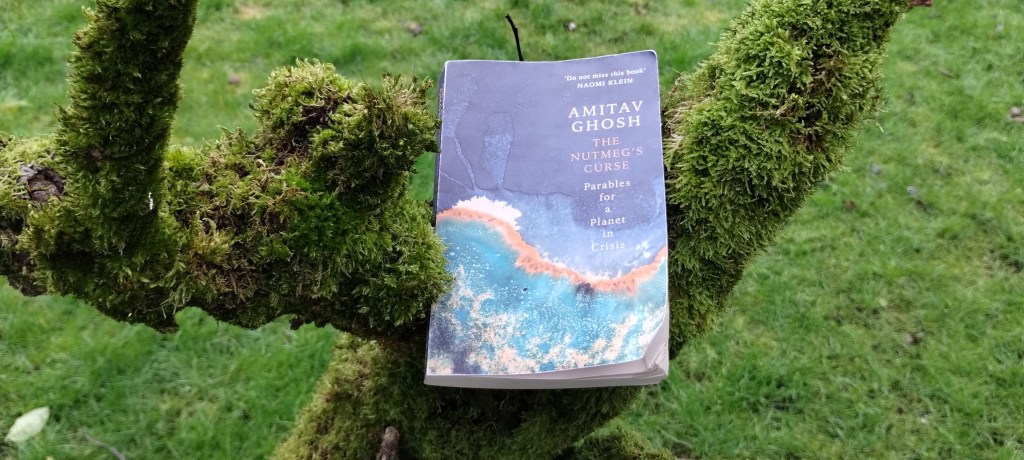
The humble nutmeg precipitated a colonial atrocity in the 1600s. A massacre that forms part of the dirty rapacious history of appropriating nature as a resource for exploitation that bred capitalism and modernity and trampled over indigenous peoples.
I’ve just finished reading Amitav Ghosh’s ‘The Nutmeg’s Curse – Parables for a Planet in Crisis’. It’s a deep thinking read but timely as we currently bear witness to an epitome of disconnectedness from Mother Nature and naïve, arrogant thirst for elitist power and profit.
If you want a vivid sense of enlightenment to an age of brutal colonialism and terraforming (terror-forming) of nature and peoples, this book provides it.
As I read, I was on the look out for the most vivid quotes but by the end I had lost count of the pages I’ve marked where candidates lie.
Here are a few:
“While Native peoples have been massacred and fought, cheated, and robbed of their historical lands … today their lands are subject to some of the most invasive industrial interventions imaginable”
“But now the face of all the land is changed and sad. The living creatures are gone. I see the land desolate and I suffer an unspeakable sadness”
“the Company was obsessed by the eradication campaign”
“As we watch the environmental and biological disasters that are now unfolding across the Earth, it is becoming even harder to hold onto the belief that the planet is an inert body that exists merely In order to provide humans with resources” – Ghosh in turn points to Mother Nature fighting back.
I was very taken by a section on trees, tree hugging, and the possibility that as fellow beings, trees are playing the long game when it comes to the monstrous ways of humans:
“Trees have inhabited the Earth much longer than human beings, and their individual life spans are, in many cases, far greater than those of people: some live for thousands of years. If trees possessed modes of reasoning, their thoughts would be calibrated to a completely different timescale, perhaps one in which they anticipate that most humans will perish because of a planetary catastrophe. The world after such an event would be one in which trees would flourish as never before, on soil enriched by billions of decomposing human bodies.”
Ghosh also exposes the monstrosity of the military-industrial complex – massive investment in the military which is a huge consumer of energy and polluter. Military investment is substantively driven by the wish for supremacy over the very fossil fuel extraction and burning that may well spell the end of this era of so-called ‘civil’ization.
Colonialism has bred in some, a belief that they are the crowning race and have some immunity from what the crisis may have in store – “former settler colonies who do not flinch from the prospect of accelerating, rather than slowing, climate change”.
Anyone seduced by the notion of making their country great again should have a long hard look at this book.
💚 💙 🤘

Thoughts, insights and rants about futures, climate change, system change, transport, wicked problems, EDI, and heavy metal
By Professor Glenn Lyons
 What the hell is going on?
Leave a comment