
Karen McShane is one of the most inspirational women I know. I am proud to know her as a friend and colleague. It therefore saddens me that she has been given an amplified sense of being othered by a recent supreme court ruling.
We have been taking important steps forwards towards a more inclusive society that respects and tries to better understand difference. Yet accompanying steps forward are steps backwards. The dark underbelly of society seems to reveal itself and its prejudice, fear of difference, and ignorance – whether to do with gender, ethnicity, religion, socio-economic standing, brain wiring or science.
I’m reminded of the stages of competence model that speaks to any and all of these dimensions of difference. The model points to a notional sequence for each of us, we can be:
(1) unconsciously incompetent – we make (hurtful) missteps without even knowing it;
(2) consciously incompetent – we make (hurtful) missteps but are self-aware of doing so;
(3) consciosly competent – we work at avoiding the (hurtful) missteps by making the effort to do so (resisting learned behaviours or instincts to do otherwise); and
(4) unconsciously competent – we avoid making (hurtful) missteps without even having to think about it because we have become inherently more inclusive of others.
We can move forwards and (slip) backwards between stages over time.
Some of us have felt shame at exhibiting stage (1) or (2) that propels us to want to do better, to think more and learn more and move ourselves to stage (3). Sadly, I believe some have no shame in exhibiting (1) or (2). Some in (1) are exploited or maniplated by others (who seem motivated by stoking up prejudice). Worst of all, some *appear* to wilfully exhibit (2).
Which brings us to the supreme court ruling on gender and what sense each of us in society is making of it. Some will be oblivious to its detail. Some may jump to assuming in some way it vindicates their prejudice against transgender people. Some may challenge themselves and ask ‘do I really understand this ruling and its implications for a more inclusive society?’.
I would encourage everyone to read the excellent short article: ‘The Guardian view on the UK supreme court’s equality ruling: a clear legal line, a blurred social one’.
“the UK supreme court has found that, under the EqualityAct 2010, “sex” means biological sex – an unambiguous legal position with profoundly ambiguous social consequences”.
“Many women’s rights advocates saw the ruling as a firm defence of sex based rights, especially where privacy from those perceived as male feels essential. A great number of trans people felt devastated by a judgment they fear will be weaponised.”
“while the ruling gives service providers the legal power to exclude trans women from single-sex spaces, it doesn’t mandate it – a reminder that clear laws shouldn’t license quiet exclusions”.
Let’s all try our best to be (3) or (4) on this important matter.
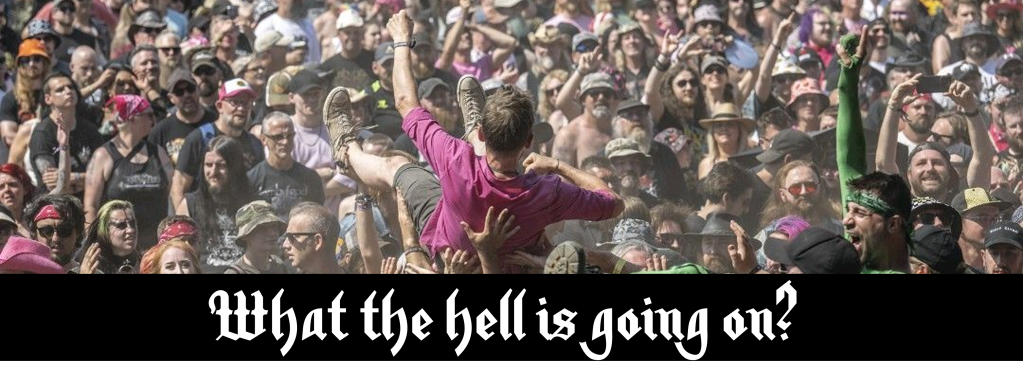
This post is in response to a post from Karen and I have used her post image here.
Karen’s post is here.
 What the hell is going on?
Leave a comment