
By Glenn Lyons and Greg Marsden
Download for free our new paper [1] that critically examines the history of road traffic forecasting in England from 1989 to 2018 in terms of the treatment of uncertainty and in turn brings into question how uncertainty is addressed in scheme appraisal guidance.
In a team effort with equal contributions from both authors, we point to the challenges facing transport planning’s forecasting paradigm in a time of deep uncertainty and explore the prospect of a new or revised transport planning paradigm emerging.
We introduce a family of terms:
Opening out – embracing the extent of uncertainty faced
Closing down – the process of narrowing the plurality of futures for the purpose of informing targeted policymaking action
Shutting down – concealing some of the acknowledged uncertainty revealed by opening out
Opening up – movement within transport planning and policymaking to change the treatment of uncertainty
Here are some takeaway messages from the full paper:
Deep uncertainty about the future is a wicked problem – The UK Department for Transport’s (DfT) 2018 road traffic forecasting exercise acknowledges that “[w]hile uncertainty in road traffic demand has always existed, it is perhaps now more uncertain than ever”. Handling uncertainty constitutes a wicked problem in that it is difficult or impossible to solve (satisfactorily) in terms of our traditional forecasting paradigm. Yet there is a need for uncertainty to be accommodated in informing decision making in a way that is appropriate both in terms of analytical rigour and ease of communication, thereby supporting rather than paralysing policy and investment decisions.
An ideal case study – The approach to decision making in England is highly codified (and we believe has been world leading) with clear documented guidance regarding how to treat uncertainty. Forecasting from the past three decades (1989-2018) and appraisal documentation allows us to examine how the approach has evolved over time. Road traffic forecasts have provided one of the most significant reference points for informing and justifying policy and investment decisions in transport at a national and (with further detailed modelling) a more localised level.
The evolution of opening out – Road traffic forecasting exercises produce a fan of forecasts depicting a range of trajectories for road traffic dependent upon assumptions over future states of key drivers of demand. Until 2015, such exercises depicted a ‘central’ forecast deemed to be most likely around which the other forecasts constituted sensitivity testing of the assumptions. In the 2015 and 2018 exercises, the approach has changed significantly (if not necessarily substantially). There is no longer a most likely forecast but instead a set of plausible scenarios for how road traffic could change, still producing a fan. Surprisingly (perhaps) the extent of uncertainty in levels of future road traffic appears to have gone down rather than up moving from the 2013 to the 2015 and in turn 2018 road traffic forecast fans. We suggest that judgement over how uncertainty in population change (a key driver of traffic growth) is treated in a forecasting exercise helps explain this. Remarkably in 2015, no uncertainty in population change was considered. We deduce that opening out is bounded by institutional decisions (that have not been systematic) about which uncertainties are allowed into a particular forecasting exercise and how they are treated. The challenge for forecasting exercises of accounting for political backing for new and uncertain developments affecting road traffic has also become strongly apparent more recently with electric vehicles and autonomous vehicles a case in point. It appears to be a case of ‘damned if you do or damned if you don’t’.
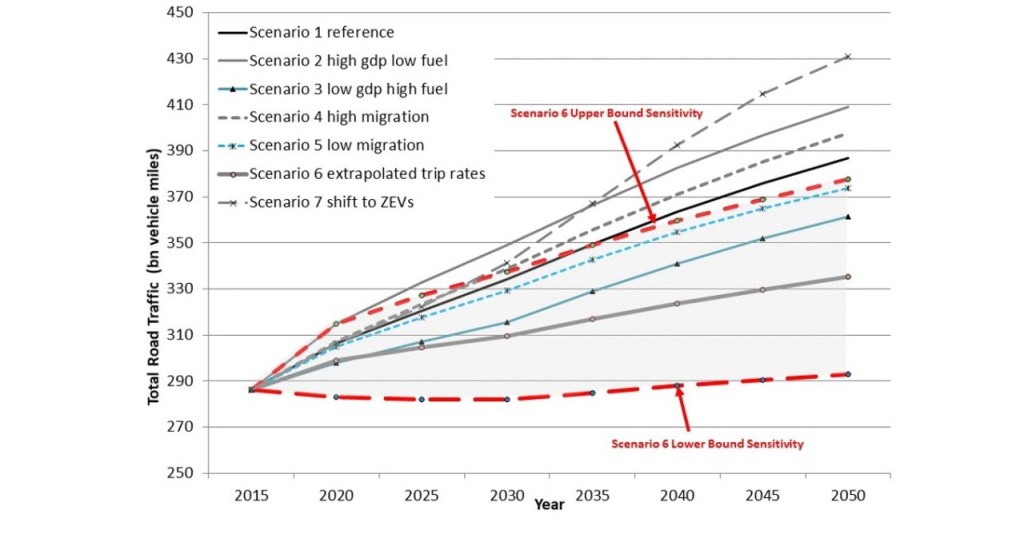
A disconnect between opening out and closing down – Notwithstanding the points above, the range in plausible road traffic growth is considerable – 17-51% from 2015 to 2050 according to latest forecasts. How is this addressed when turning to appraisal guidance for considering policy options and transport schemes? Local scheme appraisers build a core scenario based upon central macroeconomic estimates (the scenario 1 reference forecast for 2018) and then add in any locally understood variation. To test for the robustness of the scheme under different future assumptions they apply a formula to reflect uncertainty. We conduct a thought experiment to show what those assumptions look like when they are applied at the national scale. The 2018 road traffic forecasting exercise states that “[a]ll 7 scenarios are considered to represent plausible futures and thus all scenarios should be taken into account when using the forecast results”. Yet in spite of this, as the diagram below shows, scheme appraisal guidance on scope of uncertainty (the red dotted lines) centred upon the reference scenario 1 would rule scenarios 6 and 7 out of scope. The guidance also suggests that a focus upon the core scenario “should represent the best basis for decision making given current evidence” implying that scenarios 6 and 7 are (out of scope) test extremes rather than being plausible scenarios of any material significance. In our full paper we also highlight how appraisal guidance upper and lower bounds for uncertainty are predicated on which of the plausible scenarios is chosen to be deemed ‘core’. Why is scenario 1 in the diagram below more likely than scenario 6 in this regard? The answer matters hugely to how policy and investment decisions are informed (see the diagram at the top of this LinkedIn article). We suggest that the inconsistency between forecasting (opening out) and appraisal (closing down) needs addressing to avoid the risk of closing down amounting to shutting down.

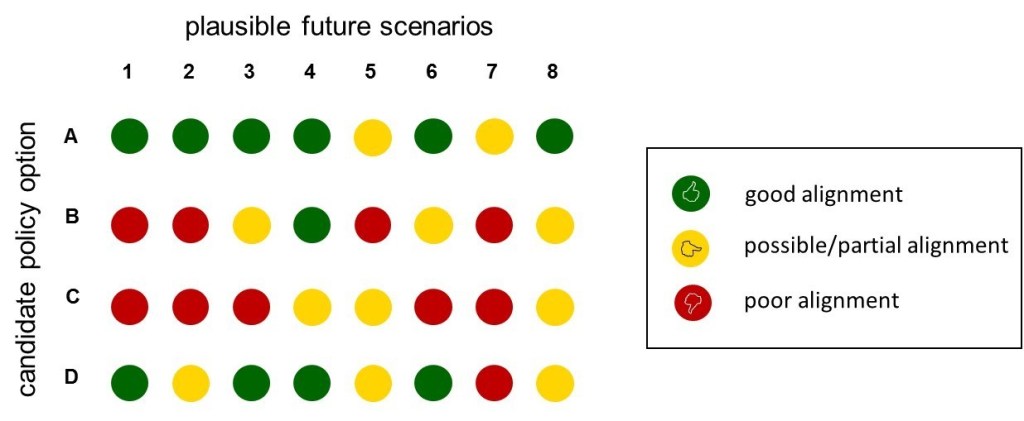
Opening up new prospects for transport planning – There are encouraging signs that a transition is underway towards a new regime of transport planning. The DfT has a new Appraisal and Modelling Strategy in which a need for “better tools to capture and communicate uncertainty to decision makers” is pointed to. There appears (growing) professional appetite for regime transition. The Chartered Institution of Highways & Transportation’s CIHT FUTURES initiative revealed greater collective belief among 200 UK transport professionals in the plausibility of a future scenario showing a substantial decline in total car traffic than in the scenario depicting growth aligned to that for central macroeconomic estimates. This is incongruous with the results of the current forecasting paradigm, even accounting for its latest efforts to evolve. There was widespread support for a policymaking approach in which uncertainty is more strongly embraced than is currently the case in the orthodox approach. Such a new approach is now not only proposed but is being introduced into practice (including its use in supporting the recently published draft National Transport Strategy in Scotland and the ‘six-stage vision-led approach to strategic planning for an uncertain world’ called FUTURES). Opening out and closing down in such an approach is illustrated in the diagram below. Scenario planning is used to generate a set of plausible ‘do nothing’ future scenarios against which candidate ‘do something’ policy options can be qualitatively and quantitatively tested for their degree of alignment with progressing towards a vision for a preferred future. This helps in reconciling risk and yield in the decision making process.
Changing hearts and minds – Whether and to what extent the norms of transport planning practice will change in the months and years ahead remains to be seen. The answer may well rest upon whether or not it is possible to challenge and change the norms of what constitutes acceptable or proportionate analytical robustness and being able to communicate analysis clearly. Proportionality is an important analytical consideration with value to be found in a breadth of examination of policy options within the uncertainty space rather than being drawn prematurely to a narrower in-depth examination of (perhaps fewer) options in the context of fewer do-nothing scenarios (or even only one scenario). We suggest that it is better to be approximately right than precisely wrong when betting on an uncertain future. There is much inertia to overcome from the incumbent paradigm yet early signs are encouraging with a growing number of authorities now exploring this approach.
We would really value your views on this article. Please consider sharing the article with your own network to promote further discussion.
Footnote: For avoidance of doubt and confusion, there are two of us (Glenn and Greg) and our names are not interchangeable or pseudonyms for one another in spite of the many instances in our careers where we are mixed up, including in the first attempt to publish this journal article.
[1] Lyons, G. and Marsden, G. (2019). Opening out and closing down: the treatment of uncertainty in transport planning’s forecasting paradigm. Transportation, in press. https://doi.org/10.1007/s11116-019-10067-x
 What the hell is going on?
Leave a comment