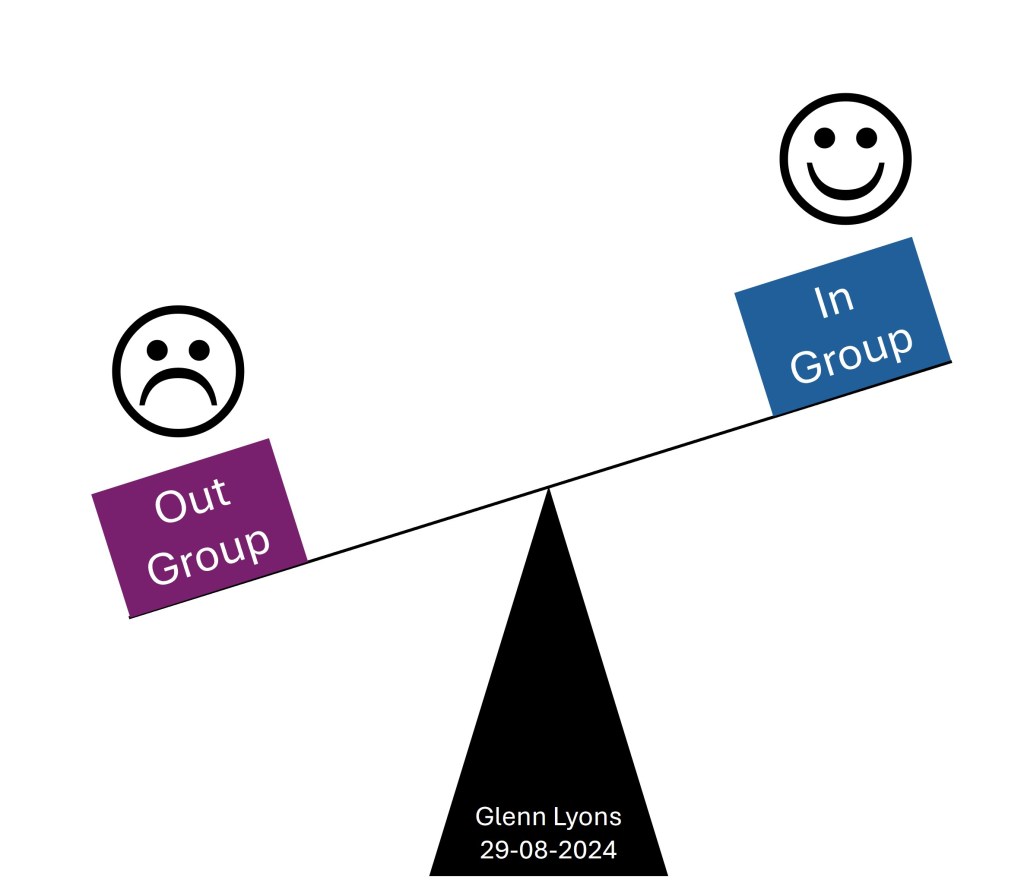
A good friend of mine pointed me to social identity theory. In a nutshell if you belong to the in-group you begin to favour it and become hostile toward the out-group and feel superior to the out-group. Self-esteem and status increase due to belonging to the ‘superior’ in-group. This helps explain prejudice against out-groups (thanks studysmarter.co.uk for that).
I’ve read various online articles challenging the notion of white male privilege indicating that in fact being white and male is starting to wrongly feel like you are in the out-group. Perhaps this partly explains why there are news articles in the US about corporations backing away from equality, diversity and inclusion because they are being ‘called out’ by a particular influencer on Twitter – search for this news article online from a few hours ago – “Ford Motor Company joins the likes of Harley-Davidson, Lowe’s and John Deere to scale back diversity, equity and inclusion efforts”.
Personal stories I’ve read point out that being white and/or male doesn’t necessarily mean you have an easy ride through life (compared to others who are white, male or otherwise).
But this to me seems to be missing the point. Here is how I make sense of it:
1. Society is complex and generalisations are challenging to make.
2. Privilege cuts across different characteristics. For example, people of any gender or ethnicity can be born into money – that’s financial privilege.
3. The notion of privilege is that *all else being equal* someone in the out-group is at a disadvantage to someone in the in-group.
4. Where there are finite opportunities there is a zero-sum game situation – e.g. if a position on a board or role in a business goes to someone in the out-group then someone in the in-group has lost out.
5. When the scales are tipped (e.g. through promoting equality, diversity and inclusion), the out-group feels things in society are on the up, but the in-group feels things going down.
6. Those in the in-group can then feel as though they have become disadvantaged, which may be true in terms of a reference point back in time before the scales tipped. They may also fail to grasp that this could be how many in the out-group had been feeling for generation after generation.
7. Feeling individually disadvantaged may lead to resentment and and a sense of discomfort towards EDI and perhaps an inclination to call it ‘woke’.
8. In some parts of societies, in some organisations, in some social networks, the scales are more balanced than in others. But as a whole in society, the scales remain distinctly tilted.
Feel free to challenge my logic.
The Powerpoint file I created to produce the animation for this post is here:
 What the hell is going on?
Leave a comment